A charter agreed at sea
14th August 1941: Aboard warships in a quiet Newfoundland bay, two leaders set their names to a short statement of war aims that reaches far beyond the war itself.
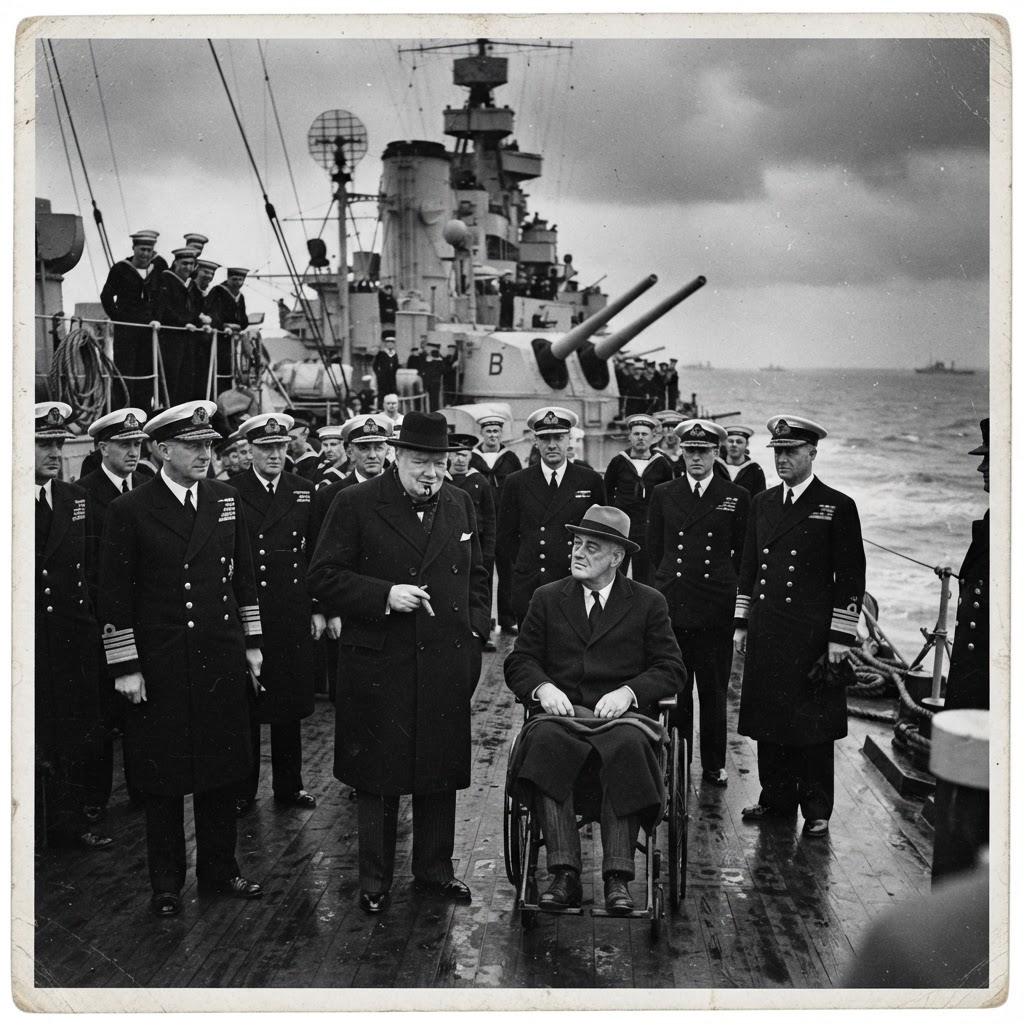
The two men had never met before, and the meeting itself had been arranged in such secrecy that even their closest staff learned of it only at the last moment. For several days their ships lay at anchor in a grey Atlantic bay while the leaders talked, dined, and worshipped together on a crowded quarterdeck, the sailors of both nations pressed shoulder to shoulder around them.
What emerged was not a treaty and not an alliance — one of the two nations was, after all, still formally at peace. It was a statement of principles: a short list of the things the war was supposedly being fought to secure. No territorial gains sought. No changes made against the wishes of the peoples concerned. The right of all peoples to choose their own government. Freer trade, better labour standards, and a peace that would let men live out their lives free from fear and want.
"It was," one official wrote, "a remarkable thing to put on paper in the middle of a war one is losing. We were promising the shape of a better world before we had the least idea how we were going to survive the present one."
The cynics noted the gap between the words and the facts. Great empires do not easily grant to others the self-government they set down so grandly on paper, and the contradiction would be thrown back in the authors' faces for decades. Yet the words, once written, could not be unwritten, and men in colonies and occupied countries alike would hold their rulers to them.
For now the significance was quieter and more immediate. A nation still officially neutral had stood up beside one at war and, in careful language, told the world whose side it was on. The document changed no front line that August. But everyone who read it understood that a corner had been turned.