Welcome to a prisoner-of-war camp
16th August 1941: British troops begin to fill up a large camp already familiar to French prisoners, soon to be familiar to many more.
Sergeant Doug Palmer had been serving with a heavy anti-aircraft battery when he was left behind at the end of a losing campaign, along with several thousand other British, Australian and New Zealand troops, and forced to surrender. He endured the slow, filthy journey by rail into Germany with little more than thin soup to sustain him — "it went straight through you," he said — and arrived at the great camp in the middle of August.
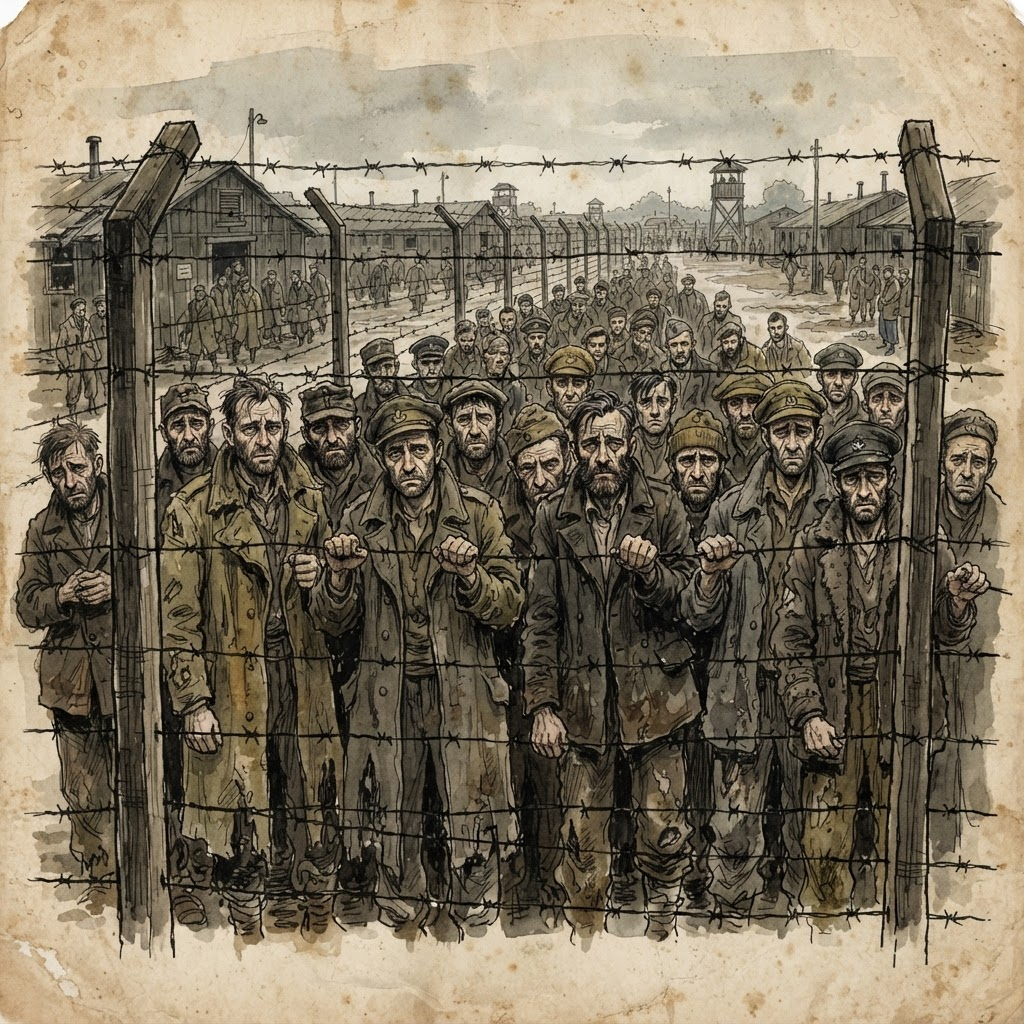
The camp was not new. It had been built to hold the prisoners of an earlier phase of the war, and thousands of Frenchmen had already worn its paths smooth and given its huts their nicknames. To the newcomers, stumbling down from the cattle trucks, it seemed less a prison than a small, grim town — rows of wooden barracks behind a double fence of wire, watchtowers at the corners, and everywhere the smell of too many men in too little space.
The reception followed a routine the older prisoners knew by heart. The men were counted, searched, counted again, deloused, and photographed with a number held under the chin. Each was given a metal identity disc and a place in a hut, and each learned within a day the two facts that governed everything: that there was never quite enough food, and that time, from now on, would have to be endured rather than spent.
"You made a life of the small things," Palmer wrote long afterwards. "A brew of tea, a letter from home three months old, a football match got up between the huts. You had to, or the days would have swallowed you."
For the French, who had watched the wire go up around themselves a year earlier, the arrival of the Commonwealth men was a strange kind of company — proof that the war had not ended with their own defeat, and a reminder that the camp, already crowded, would only grow more crowded still.
In time the same huts would receive men of other armies again, until the camp became a byword for the whole experience of captivity: the boredom, the hunger, the small acts of defiance, and the long, patient waiting for a war whose end no one could yet see.
Keep reading with a free trial
Subscribe to World War II Today to keep reading this post and get access to the full archive of daily dispatches from the Second World War.
Subscribe